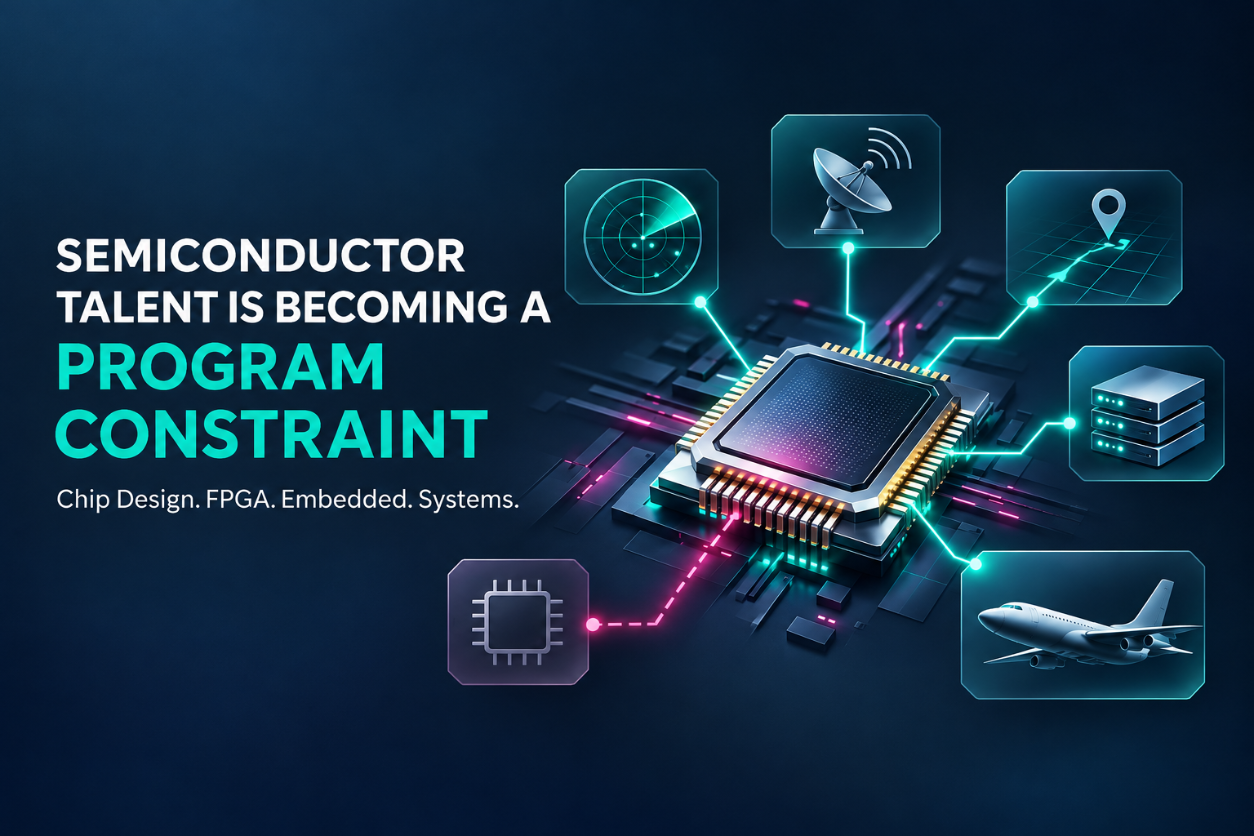
Semiconductors have spent the last several years at the center of conversations about domestic manufacturing, supply-chain resilience and national security.
There is another constraint developing alongside production capacity: the people who design, integrate and apply the technology.
Aerospace and defense systems increasingly depend on advanced computing, sensing, communications, autonomy, electronic warfare and AI at the edge. Behind those capabilities are highly specialized engineers working across chip design, FPGA development, embedded systems, RF, systems integration and related disciplines.
The supply of that talent is already under pressure.
In its 2026 workforce blueprint, the Semiconductor Industry Association projects the U.S. semiconductor industry will add roughly 114,800 jobs by 2030. At current rates, approximately 67,000 of those jobs could go unfilled, including an estimated 27,300 engineering roles.
That pressure does not stop at the semiconductor industry. Aerospace, defense, AI, robotics, automotive and advanced manufacturing need many of the same technical capabilities.
For A&D leaders, the semiconductor talent shortage is becoming a constraint on the systems and programs that depend on that expertise.
Advanced Microelectronics Is Becoming Core to More A&D Systems
The importance of microelectronics extends far beyond the chip itself.
Advanced semiconductors support sensing, communications, autonomy, AI, electronic warfare, advanced computing and secure systems. As those technologies become more central to aerospace and defense programs, the engineering expertise behind them becomes more important too.
In July 2026, the U.S. Department of Commerce announced new CHIPS R&D investments spanning integrated photonics, advanced packaging, compute architectures and memory, with applications that include robotics and defense systems.
These technologies do not operate in isolation. They have to be designed into larger systems, integrated with hardware and software, tested against demanding performance requirements and supported through development and production.
As the underlying technology becomes more sophisticated, the workforce behind it has to keep pace.
The Talent Gap Extends Beyond Semiconductor Manufacturing
The semiconductor workforce challenge is often discussed in terms of fabs and production capacity. For aerospace and defense leaders, the engineering side of the gap matters just as much.
SIA estimates that roughly 27,300 engineering positions within the semiconductor industry could go unfilled by 2030. Those shortages affect several capabilities that sit close to A&D system development.
Chip and Hardware Design
Advanced semiconductor development requires engineers working across areas such as digital and analog design, verification, RF, photonics, system-on-chip architecture and advanced packaging.
Many of those skills take years to develop, and the same expertise is valuable across defense, aerospace, commercial technology and other advanced industries.
FPGA and Embedded Engineering
FPGA engineers sit at the intersection of hardware and software, combining digital logic, embedded systems, VHDL or Verilog, timing analysis, simulation and hardware validation.
That combination of hardware and software expertise is valuable in aerospace, defense, communications, medical devices, robotics and advanced manufacturing, which puts additional pressure on an already specialized talent pool.
Systems Integration
Individual components still have to work inside a larger system.
Systems engineers, embedded engineers and hardware/software integration specialists connect those technologies to the broader product or platform. In complex aerospace and defense environments, that often requires enough technical depth to understand how multiple disciplines interact.
That makes the talent challenge broader than finding someone who understands a particular chip, tool or architecture. Organizations also need people who can apply that expertise within the larger system the technology is meant to support.
Commercial Demand Is Tightening the Defense Talent Pool
The competition for specialized technical talent extends far beyond traditional defense employers.
NDIA’s 2026 Vital Signs research found that lack of qualified candidates and competition with the commercial sector continue to be leading barriers to filling defense-industry positions. More than half of respondents also reported difficulty hiring workers with STEM specialties.
Semiconductor companies need chip designers and hardware specialists.
AI companies need compute, accelerator and edge expertise.
Robotics and autonomous-systems companies need embedded, sensing and systems engineers.
Aerospace and defense organizations need many of those same capabilities, sometimes with additional requirements around security clearances, program experience or highly specialized technical environments.
That reflects a broader shift in the technical talent market across aerospace and defense. Specialized engineers increasingly have opportunities across multiple industries, and employers may be competing with companies they have never traditionally viewed as talent competitors.
Defense Microelectronics Is Already Treating Talent as Strategic Infrastructure
The investment going into microelectronics workforce development shows how important the issue has become.
In May 2026, Purdue University announced that the federally funded SCALE program had grown to more than $100 million. The 35-university consortium is focused specifically on defense microelectronics workforce development, including areas such as system-on-chip design, compound semiconductors, heterogeneous integration, radiation hardening and trusted AI.
That same month, the National Science Foundation launched the first regional nodes of its National Network for Microelectronics Education, bringing together more than 300 organizations to strengthen education and workforce pathways across the U.S. microelectronics industry.
Those investments show how seriously the U.S. is treating microelectronics workforce capacity.
Microelectronics talent is increasingly being treated as part of the infrastructure required to sustain U.S. technology and national-security capability.
Those long-term investments are essential. They also do not solve the immediate workforce challenge facing organizations that need specialized expertise for programs already underway.
Specialized Roles Get Harder to Fill When Requirements Stack Up
A semiconductor or embedded engineer may already belong to a limited talent pool.
That talent pool can narrow quickly once the role becomes program-specific.
A role may call for specific FPGA or ASIC architecture experience, VHDL or Verilog, embedded software, RF or signal processing, system-level knowledge or experience with a particular platform or toolchain.
For defense work, technical specialization may be only one filter. Clearance, location, program experience and timing can narrow the market further.
Some of those requirements are essential. Others may be inherited preferences that deserve another look.
A strong engineer with relevant experience in semiconductors, robotics, telecommunications or another highly technical field may bring capabilities that transfer well to an aerospace or defense environment even if the résumé does not match the previous person in the role.
Technology and engineering leaders need to be clear about which expertise has to be present on day one, where adjacent experience may translate and what can realistically be learned on the job.
Workforce Planning Has to Follow the Capability Roadmap
For highly specialized technical talent, workforce planning works best when it starts with the capabilities the organization expects to need.
Map the Critical Capabilities Early
Look beyond job titles and identify the expertise future products, platforms and programs will depend on.
Where will the organization need FPGA, embedded, chip-design, RF, AI hardware or systems expertise? Which of those capabilities take years to develop? Where could a strong engineer from an adjacent technical field realistically transfer in?
Those questions are easier to address while the technical roadmap is being developed than after a program is already waiting for someone with a difficult-to-find skill set.
Getting clear on the difference between scarce expertise and trainable skills can also widen the talent pool without compromising the standards the work requires.
Build Relationships Before the Capability Becomes a Bottleneck
Highly specialized engineers may not be actively looking for a new role when the need appears.
Early talent mapping and relationship-building can give organizations a clearer view of where expertise exists, how competitive the market is and which capabilities may take longer to secure.
That gives technology and engineering leaders more time to plan around the hardest talent constraints instead of discovering them after the work is already underway.
Create More Than One Way to Access Expertise
Not every technical need has to be solved through the same workforce model.
Permanent hiring may make sense for long-term strategic capability. Contract talent can provide specialized expertise during a critical development phase. Contract-to-hire or project-based support may provide additional flexibility when program requirements are evolving.
The right model depends on the work, the duration of the need and how quickly the capability has to be in place.
STRATEGIC TAKEAWAY
The semiconductor talent gap is becoming a capability issue for aerospace and defense.
As advanced systems depend more heavily on specialized microelectronics, FPGA, embedded and systems expertise, workforce availability can affect how quickly organizations develop, integrate and deliver the technology.
Talent risk should be part of the technical roadmap from the beginning, especially when the program depends on expertise that is already difficult to find.
Build the Expertise Behind the System
Advanced aerospace and defense systems increasingly bring technology and engineering disciplines together.
Digital Prospectors supports specialized talent across Engineering, including R&D, product development, manufacturing and complex technical programs, as well as Technology environments spanning software, infrastructure, data, AI, cybersecurity and systems integration.
We also support specialized FPGA, embedded, semiconductor and cleared engineering needs where the talent pool can be especially difficult to reach.
Whether the need is permanent expertise, contract support or additional capability for a defined project, the workforce model should fit the work.
When critical technology depends on scarce expertise, workforce planning has to be part of the program strategy.